How canal locks work: raising and lowering boats between water levels
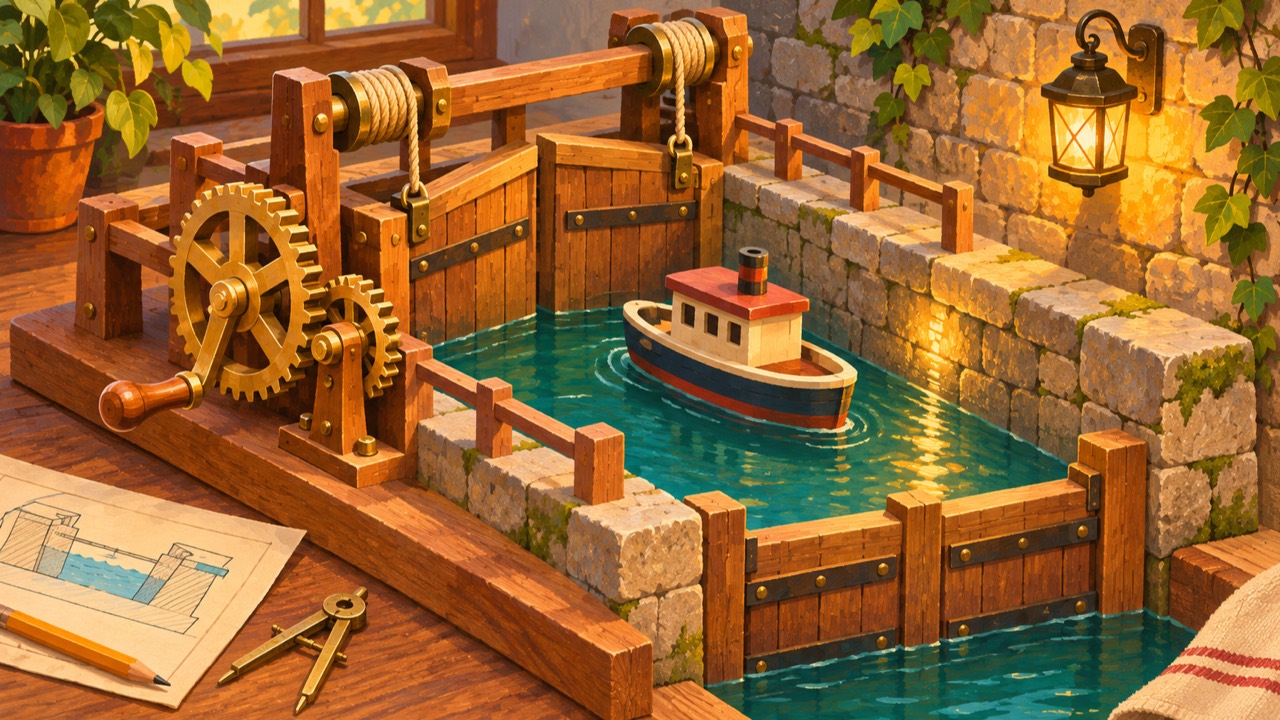
A lock raises or lowers the water in its chamber so boats can travel between waterways at different heights. In the U.S. Army Corps of Engineers' gravity lock example, the gates are closed to control filling and emptying, and the matching gate opens once the water levels are equal.
1. Think of the chamber as a water elevator
The boat enters a chamber whose water level can change, then rises or falls with the surface. The Corps' diagram shows upper and lower water levels, gates at both ends, and filling and emptying valves.
2. Match the entry-side water level
For a downstream trip, close both sets of gates and the emptying valve, then open the filling valve until the chamber reaches the upper level. Open the upper gates for the boat to enter.
3. Close the gates before lowering the boat
Once the boat is in the chamber, the upstream and downstream gates and the filling valve are closed and the emptying valve is opened. Water flows toward the lower side and the boat goes down with the surface; the whole gate is not simply opened to let the boat rush down.
4. Open the exit gates at the matching level
Once the chamber reaches the lower level, open the lower gates and let the boat leave. Reverse the operation to raise a boat. This system lets water seek its own level without pumps.
5. Read the game's separate gate rules
In Lockwater, tapping a gate permanently levels the water on both sides, and tapping a boat sends it through open gates to the flag of its color. It turns water levels and gate order into a puzzle and should not be taken as a real lock's operating procedure.
Sources: www.publications.usace.army.mil/Portals/76/Publications/EngineerPamphlets/EP_870-1-20.pdf · apps.apple.com/tw/app/%E6%B0%B4%E9%96%98-lockwater-%E9%81%8B%E6%B2%B3%E8%A7%A3%E8%AC%8E/id6826767889

 Roomory

 Hearscape

 Splash Car